Audio feedback is a ringing sound (often described as squealing, screeching, etc.) sometimes present in the sound system. This is due to a “loop signal”, i.e. a signal that travels in a continuous loop.
In technical terms, feedback occurs when the gain in the signal loop reaches “unity” (0dB gain).
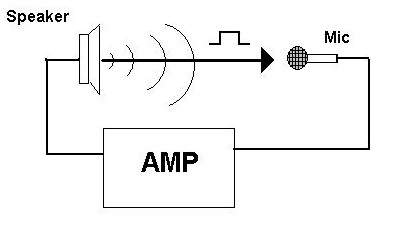
One of the most common feedback situations is shown in the diagram below – the microphone feeds a signal to the sound system, which then amplifies and outputs the signal from the speakers, which is picked up again by the microphone.
How it Works
Feedback only occurs when the microphone picks up critical sound levels from the speaker projecting the microphone signal.
- The microphone picks up sound and converts it into an audio signal
- The audio signal is sent to the loudspeaker and amplified as sound
- Microphone picks up sound from loudspeaker
- A bigger signal is sent to the loudspeaker and it gets louder
- This creates more sound to pick up from the microphone
- The cycle continues and turns into feedback
In short, feedback is a loop of sound. When a microphone picks up sound and the signal from that microphone is played through a speaker system near the microphone, feedback can occur because a loop is created. The speaker plays what the microphone picks up and the microphone picks up what the speaker is playing.
Feedback depends on the following:
- Microphone sensitivity
- Loud speaker
- Distance between speaker and microphone
The microphone is intended to capture the sound waves of something close by, such as a person's voice or an instrument. When the microphone captures the sound, the signal is routed through a cable into a device to process the signal, amplify it, and then play it through a speaker, thus making that voice or instrument sound much louder. Where the feedback occurs is when the speaker is creating sound waves that reach the microphone and the loop is created.
Sound feedback occurs when the volume of the microphone signal playing through the speaker reaches a threshold where it starts playing the microphone signal louder each time it passes through the loop. The speaker amplifies the microphone signal so that if the microphone is too close to the speaker amplifying the same signal, the microphone will pick up its own signal in real-time and amplify the signal louder and louder each time it passes through the speaker. The signal begins to grow in volume and quickly causes a feedback loop. Feedback sounds usually have a very high frequency or pitch, and are usually very loud.
To get rid of feedback, you must interrupt the feedback loop.
Here are some suggestions for controlling feedback:
- Change the position of the microphone and/or speaker so that the speaker output isn't feeding directly into the mic. Keep speakers further forward (i.e. closer to the audience) than microphones.
- Use a more directional microphone.
- Speak (or sing) close to the microphone.
- Turn the microphone off when not in use.
- Equalise the signal, lowering the frequencies which are causing the feedback.
- Use a noise gate (automatically shuts off a signal when it gets below a certain threshold) or filter.
- Lower the speaker output, so the mic doesn't pick it up.
- Avoid aiming speakers directly at reflective surfaces such as walls.
- Use direct injection feeds instead of microphones for musical instruments.
- Use headset or in-ear monitors instead of speaker monitors.